An ultralight backpacking gear list covers the same categories as any kit: shelter, sleep system, pack, clothing, water, kitchen, navigation, light, first aid and repair. The difference is that the gear you carry adds up to a base weight under about 10 pounds, not counting food, water and fuel. That’s a convention, not a rule; REI puts it this way: “While there’s no official definition, you’re generally considered an ultralight backpacker if your base weight is under 10 pounds.” Most of that weight sits in the Big Three: shelter, sleep system and pack.
Below is the full list by category, with an example model and its maker-listed weight for each core item. Jump to the gear table, or copy the categories straight into the free Clever Pack Builder and fill in your own weights.
How we put this together: This is a research-based list. The example models are examples, not rankings, and weights are as listed by each maker on the date checked. None of the figures are our own measurements.
Disclosure: Clever Backpacking’s only cash income is reader donations and gear sold in our own shop. Zpacks links are marked “Ad”: they’re referral links that earn us points toward discounted Zpacks gear, not cash. No other link on this page earns us anything.
What makes a gear list “ultralight”
Every item on your list falls into one of three groups:
- Base weight: everything in your pack that isn’t food, water or fuel. This is the number to compare between kits.
- Worn weight: the clothes, shoes and anything else you hike in. It usually isn’t counted.
- Consumables: food, water and fuel, which get lighter as you go.
Hikers commonly call a base weight under about 10 lb ultralight, 10–20 lb lightweight, and over 20 lb traditional. These bands are community conventions; REI’s own bands differ a little. The Ultralight Base Weight Guide explains how to weigh yours and what to cut first.
The ultralight gear list at a glance
Weights are as listed by each maker on 2026-11-04. Check each maker’s page before you buy, and weigh your own gear on a kitchen scale.
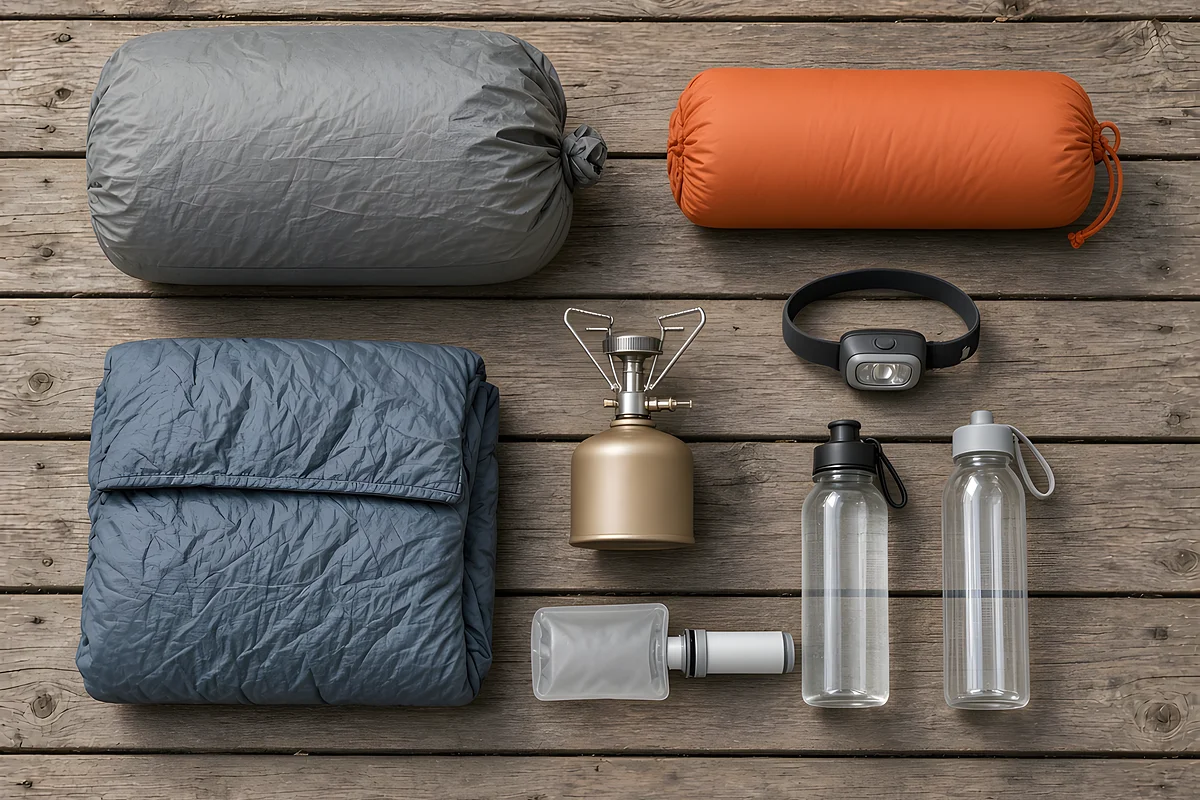
| Category | Item | What to look for | Example model | Maker-listed weight |
|---|---|---|---|---|
| Shelter | 2P trekking-pole tent | Packed weight with stakes, floor size, pitch skill | Zpacks Duplex Classic (Ad) | 17.8 oz / 504 g (Blue or Olive Drab; stakes not included) |
| Shelter | Alternative | Same, with a larger floor | Zpacks Duplex Pro (Ad) | 19.2 oz / 544 g with Lite floor |
| Pack | Framed pack, ~60 L | Torso fit, frame, load range, hipbelt | Gossamer Gear Mariposa 60 | Medium: 34.2 oz / 968 g with S Straight belt |
| Sleep | Insulated air pad | R-value for your lows, thickness, width | Therm-a-Rest NeoAir XLite NXT (Regular) | 13 oz / 370 g; R 4.5 |
| Sleep | Comfort pad (heavier) | Loft for side sleepers | NEMO Eclipse All-Season (Regular) | 1 lb 0 oz / 460 g minimum; R 6.2 |
| Sleep | Quilt hybrid | ISO comfort rating vs your lows | Sierra Designs Cloud Quilt 800F 20° | 1.69 lb / 0.76 kg; ISO comfort 32°F |
| Sleep | Down mummy bag | Comfort vs limit rating, fit | Western Mountaineering UltraLite 20°F | 1 lb 13 oz / 820 g (6’0″ size) |
| Kitchen | Canister stove | Boil only or simmer, cold output, fire rules | MSR PocketRocket 2 | 2.6 oz / 73 g |
| Water | Squeeze filter | Flow, backflushing, freezing risk | Sawyer Squeeze | Filter ~3 oz (Sawyer support page); full system as sold 8.19 oz |
| Light | Headlamp | Runtime on your modes, strap comfort | Nitecore NU25 MCT UL | 47 g / 1.66 oz incl. bracket and headband |
| Clothing | Rain jacket, insulation, spare socks, warm hat, gloves | Packed layers that cover wet, cold and camp | Your choice | Weigh your own |
| Kitchen | Pot, utensil, lighter | Pot size for your meals | Your choice | Weigh your own |
| Water | Bottles or soft flasks | Capacity for your longest dry stretch | Your choice | Weigh your own |
| Navigation and safety | Map, compass, phone or GPS, power bank, first aid, repair kit, trowel | Matched to how far you’ll be from help | Your choice | Weigh your own |
| Shelter extras | Stakes and guylines, groundsheet | Stakes suited to your soil; the Duplex needs 6–8 | Your choice | Weigh your own |
Two things to notice. First, “trail” or “minimum” weights often leave out stakes, stuff sacks or a hipbelt, so the number on your scale will be higher. Second, the Big Three rows above are where most of the weight is, and where a swap makes the biggest difference.
The Big Three
Shelter
Decide in this order: capacity (1P or 2P), structure (freestanding or trekking-pole), walls (single or double), then fabric. Trekking-pole shelters in Dyneema Composite Fabric, like the Duplex, are among the lightest 2P options, but they cost more and need practice to pitch. Compare the complete weight you’ll carry, including stakes. See How to Choose an Ultralight Tent, and Are Ultralight Tents Worth the Investment? if you’re weighing the cost.
Sleep system
A sleep system is your bag or quilt plus your pad, and they work together. Choose a bag by its comfort rating from the ISO 23537 test, not its limit rating. Then pick a pad with enough R-value for the ground temperatures you expect. Quilts save weight but depend more on your pad and clothing. See How to Choose the Right Sleeping Bag for Backpacking, and our research-based comparisons of the NEMO Eclipse All-Season pad and the Sierra Designs Cloud 20.
Backpack
Choose the pack last, once you know what goes inside it. Fit and load range matter more than empty weight. A frameless pack suits a small, light load; a framed pack carries more comfortably as weight climbs. See how to choose a backpack by fit, capacity and load.
Clothing: packed layers vs what you wear
What you hike in counts as worn weight. What’s in the pack counts toward base weight: usually a rain jacket, an insulating layer, spare socks, and a warm hat and gloves. Pack enough to stay safe when it’s wet, cold and dark at camp, and skip duplicate “just in case” layers.
Water: treatment and storage
You need a way to treat water and enough bottles for the longest stretch between reliable sources. REI suggests about half a liter per hour of moderate activity in moderate temperatures, and a liter or more per hour in high heat. Water in your bottles is a consumable, but the filter and bottles count toward base weight. For a specific stretch, use the Clever Water Trip Planner, and see How Much Water Per Day Backpacking?
Kitchen and food
A small canister stove and one pot cover most solo trips. A no-cook plan can save that weight on short summer trips. Food is often the heaviest consumable. REI says “a reasonable goal is about 1½ to 2½ lbs. of food (or 2,500 to 4,500 calories) per person per day.” Our food guide explains how to find your own number. Plan your own in the Clever Trail Fuel Planner. Check local fire restrictions before you choose a stove.
Navigation, light, first aid and repair
These are small, but they’re what keep a normal trip from going wrong. Carry a map and compass you know how to use, a phone or GPS with a power plan, a headlamp, a first-aid kit sized to how far you’ll be from help, and a small repair kit. They line up with the Ten Essentials. For one example headlamp, see our research-based comparison of the Nitecore NU25 MCT UL.
Optional and trip-specific gear
Trekking poles (which double as tent poles for trekking-pole shelters), camp shoes, a head net, microspikes, or a bear canister where rules require one. Ask whether each item changes your safety, sleep or progress on this trip. If it doesn’t, leave it home.
What to cut first
- The Big Three. A lighter shelter, sleep system or pack usually saves more than everything else combined.
- Duplicates. Extra layers, a second light, a full-size toiletry kit.
- Trip-specific gear. Share a stove or filter with a partner.
- Then the ounces. Lighter pots, smaller accessories.
The Ultralight Base Weight Guide explains each step.
When not to go ultralight
Lighter isn’t always better. If you’re new to backpacking, camp in harsh weather, are hard on gear, or only get out a few times a year, a slightly heavier and tougher kit is often the smarter buy. Start with the essential backpacking gear checklist, and upgrade once you know what you use.
Build your own list
Our free tools take this list from a page to your pack:
- Clever Pack Builder: list your gear and see base, worn, consumable and total weight.
- Clever Gear Finder: narrow down a backpack, tent, sleeping bag, sleeping pad or stove by trip and weight goal.
- Clever Water Trip Planner: how much water to carry between sources.
- Clever Trail Fuel Planner: calories and food weight for your miles and climbing.
All four are on the tools page.
Sources
Checked 2026-11-04:
– Zpacks, Duplex Classic Tent: https://zpacks.com/products/duplex-tent
– Zpacks, Duplex Pro Tent: https://zpacks.com/products/duplex-pro-tent
– Gossamer Gear, Mariposa 60: https://www.gossamergear.com/products/mariposa-60-lightweight-backpack
– Therm-a-Rest, NeoAir XLite NXT: https://www.thermarest.com/sleeping-pads/fast-and-light/neoair-xlite-nxt-sleeping-pad/14011.html
– NEMO, Eclipse All-Season: https://www.nemoequipment.com/products/eclipse-all-season-sleeping-pad
– Sierra Designs, Cloud Quilt 800F 20°: https://sierradesigns.com/products/cloud-quilt-800f-20-deg-sleeping-bag-reg
– Western Mountaineering, UltraLite: https://www.westernmountaineering.com/product/ultralite/
– MSR, PocketRocket 2: https://cascadedesigns.com/products/pocketrocket-2-stove
– Sawyer, Squeeze product page: https://www.sawyer.com/product/squeeze-water-filter-system ; support questions page: https://www.sawyer.com/faqs
– Nitecore, NU25 MCT UL: https://www.nitecore.com/product/nu25ul
– REI, Ultralight Backpacking Gear Essentials: https://www.rei.com/learn/expert-advice/ultralight-backpacking-gear-essentials.html
– REI, The Ten Essentials: https://www.rei.com/learn/expert-advice/ten-essentials.html
– REI, Backpacking Food Ideas & Meal Planning: https://www.rei.com/learn/expert-advice/planning-menu.html
– REI, Hydration Basics: https://www.rei.com/learn/expert-advice/hydrate.html
– ISO 23537-1:2022: https://www.iso.org/standard/82789.html