Are Ultralight Tents Worth the Investment?
Are ultralight tents worth it? Sometimes yes, sometimes no—and the difference is rarely the marketing ounce number alone. This page is a decision framework for whether spending more (or going lighter) on shelter is a smart investment for your miles, comfort, and budget.
It is not a model picker. For capacity, seasons, freestanding vs trekking-pole, or materials, use How to Choose an Ultralight Tent. Stay here for budget vs ounces: should I spend the money / go UL on shelter at all?
Solid kit before ounce-chasing: essential backpacking gear checklist.
Key takeaways
- “Worth it” means miles + comfort + durability + budget—not grams in isolation.
- Frame ultralight tent cost as dollars per pound of base-weight savings you will actually use—not a contest for the lightest canopy.
- UL shelters tend to pay off on frequent backpacking, longer days, steep terrain, and shared 2P weight splits.
- A heavier tent vs ultralight can be smarter for beginners, harsh weather, durability needs, infrequent trips, or group comfort.
- Run a value checklist before you buy; then log the full shelter system in Pack Builder against your base weight goal.
- Feature selection (1P vs 2P, poles, fabrics) lives on the choose guide—this page stays on ROI.
What “worth it” means for an ultralight tent
When hikers ask whether an ultralight tent is worth the investment, they usually mix four questions:
- Will I hike farther or feel better? Weight saved on every mile compounds on long days and multi-day trips.
- Will I sleep as well? A lighter shelter you dread in wind or condensation is a bad buy even if the scale looks pretty.
- Will it last for my use pattern? Abrasion, UV, and stake sites matter more if you camp often or pitch on rough ground.
- Does the price fit how often I go? A premium UL shelter amortized over dozens of nights looks different than one used twice a year.
“Worth it” here is ROI for backpacking shelter—return in comfort, safety margin, and trip quality relative to cash and learning curve—not a certificate that lighter always wins. Catalog trail weight is only one input. Packed weight with stakes, guylines, and any groundsheet is closer to what you carry. Definitions and cut order live in our ultralight base weight guide.
Cost vs weight savings (honest math framing)
There is no universal dollars-per-ounce table that makes every upgrade rational. Prices move; used markets exist; and two shelters with similar headline weights can include very different pole and stake assumptions. Treat the math as a framing tool, not a spreadsheet verdict.
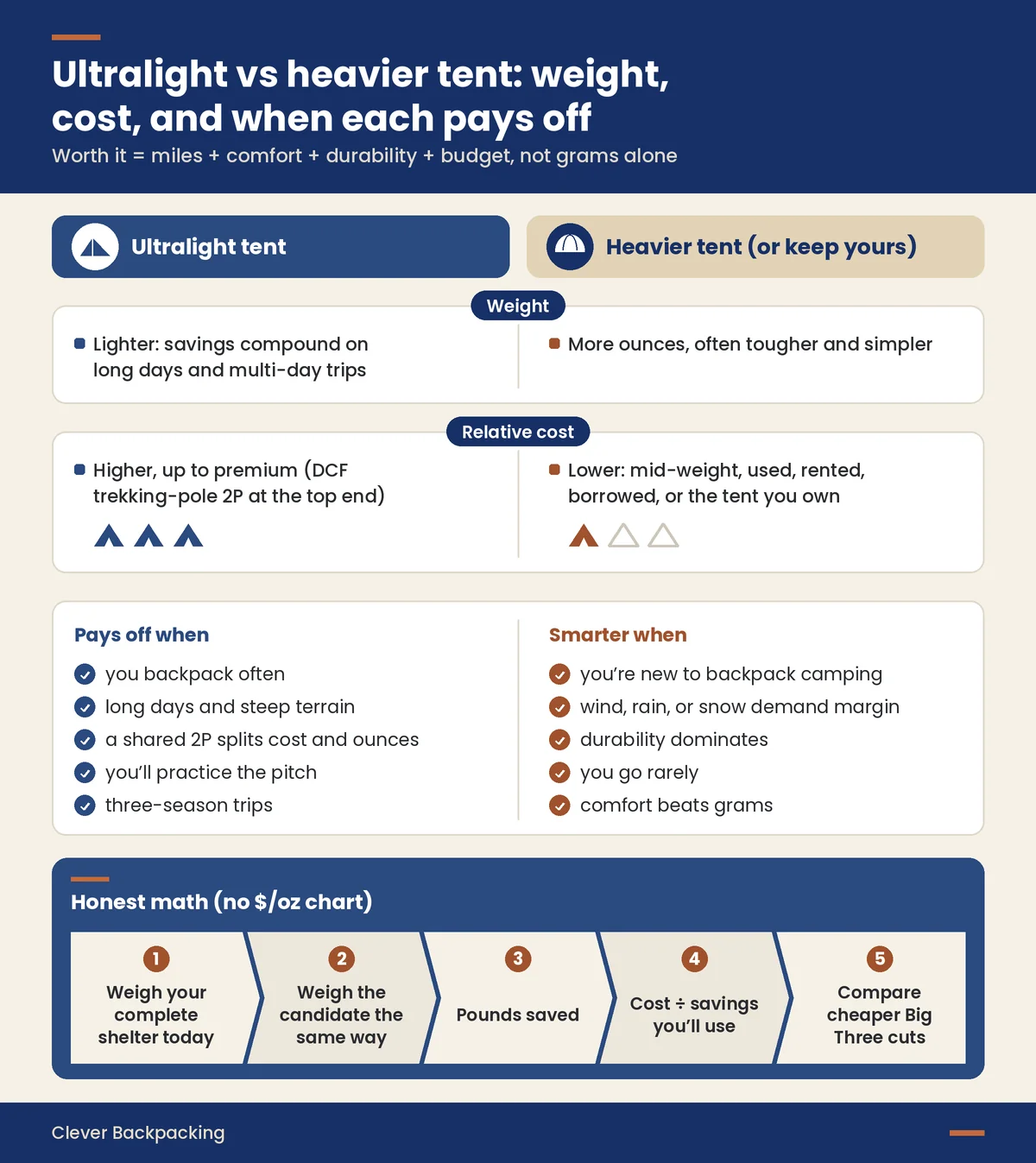
A practical way to think about ultralight tent price vs weight:
- Weigh what you carry today — Current shelter body/fly + poles (or poles you already carry) + stakes + groundsheet. Kitchen scale, not catalog claims.
- Estimate the candidate the same way — Same complete system, not a bare canopy number.
- Compute the savings — Pounds (or ounces) of base weight you would drop.
- Divide cost by savings you will use — Rough cost per pound saved, then ask how many nights and hard miles that savings will touch.
- Compare alternatives — Sometimes trimming a heavier pack, redundant clothes, or cook kit achieves similar pack relief for less money. Shelter is one Big Three lever—not the only one.
Honest caveats: shared 2P weight halves personal load; non-freestanding pitches need practice; resale can help ROI while fragile designs can hurt it. Skip invented $/oz charts—your scale and trip calendar win. If savings are small, trips are rare, or you will not practice the pitch, the heavier tent vs ultralight trade often favors a simpler, tougher, cheaper option.
When ultralight tents pay off
An ultralight shelter is more likely worth the investment when several of these are true:
- You backpack often enough to feel it. Monthly overnight trips, multi-day loops, or a long section plan amortize cost across many nights. Infrequent camping favors spending less and accepting more ounces.
- Miles and terrain punish pack weight. Long days and steep climbs make every pound noticeable. Shelter is one of the largest Big Three items you can lighten—pair it with an intentional ultralight backpack so volume and load still match.
- You will actually use the savings. Cutting two pounds only “pays” if you keep walking farther or recovering better—not if you refill the pack with extras. Track the swap in base weight.
- Shared shelter splits cost and ounces. Couples often see better ROI on one quality shared 2P than two separate shelters. Capacity details belong on the choose guide; the ROI point is that shared systems stretch dollars and grams.
- You will practice the pitch. Trekking-pole or tightly guyed shelters reward site selection. Skip practice, and freestanding or a slightly heavier double-wall may deliver better realized value.
- Season matches a lighter design. Three-season trips are the common when to buy ultralight tent case; prolonged alpine winter or extreme wind often means keeping more structure.
When a heavier tent is smarter
Going UL is not always the smart investment. Prefer a heavier tent vs ultralight—or keep what you own—when:
- You are new to backpack camping — confidence beats early ounce chasing.
- Conditions demand margin — persistent wind/rain, snow-load assumptions, or remote travel where a failed pitch is costly.
- Durability dominates — rough ground, kids/dogs, bushwhacking, hard-used shared kits.
- You go rarely — a few easy weekends rarely justify premium UL; rent, borrow, or buy mid-weight used.
- Comfort beats grams — storm-day room or a restless sleeper can outrank a sparse UL shell.
- Cheaper Big Three cuts exist — sleep, pack, or unused gear may drop base weight first (base weight guide).
- You dislike condensation or stake management — freestanding or double-wall can be higher-ROI comfort even at more ounces.
“Smarter” means better match to use. Many hikers are happiest in a solid lightweight band—not the absolute lightest canopy.
Value checklist before you buy
Work these in order. If several answers are “no,” pause—or buy a less expensive mid-weight option.
- How many nights per year will this shelter see in the next 1–2 years?
- What is my current complete shelter weight on a scale (not the catalog claim)?
- What candidate complete weight am I comparing—and how many pounds would I really drop?
- Will those pounds stay off, or will I refill the pack?
- Do my trips punish weight (miles, elevation, duration)—or reward durability and ease?
- Solo or shared? Does cost and weight split with a partner?
- Am I buying features I need, or features the internet likes? (Send structure/materials questions to the choose guide.)
- Can I practice the pitch before a remote night?
- Is there a cheaper Big Three win first? Pack, sleep, or redundancy. Sleep decisions pair with our sleeping bag guide.
- Have I logged the swap in Pack Builder so base weight, not vibes, decides?
Mostly “yes” → an ultralight upgrade is more likely worth the investment. Mostly “no” → keep cash and ounces honest, and upgrade when the trip calendar catches up.
Premium UL example: Duplex-class / DCF (value context only)
Some of the highest ultralight tent cost quotes sit in the premium Dyneema Composite Fabric (DCF) / trekking-pole 2P niche—often called Duplex-class. Treat it as a high-cost UL example, not a required purchase or ranked winner.
- Premium can make sense if you backpack a lot, want maximum three-season savings, already carry poles, will protect the floor, and accept non-freestanding skill.
- Often does not for infrequent trips, unpracticed rocky pitches, tight budgets, or when silnylon/silpoly already hits your base-weight goal.
- “Is a Dyneema tent worth it?” Only if low stretch and ounces saved matter enough on your calendar. DCF is a weight/stretch tool—not a badge.
No hard sell, no invented review URL, no podium. Compare candidates on your scale and checklist. Materials selection: How to Choose an Ultralight Tent.
How shelter ROI ties to base weight and the Big Three
Shelter upgrades show up cleanly in base weight—the gear you carry every mile, excluding food, water, and fuel. That is why tent ROI is easier to judge than gadgets that come and go from the pack.
Useful order for backpacking shelter upgrade ROI:
- Weigh today’s kit and separate base vs consumables vs worn (ultralight base weight guide).
- Look at the Big Three first: shelter, sleep system, pack.
- Stress-test a shelter swap in Pack Builder before you spend.
- Confirm pack volume still fits the sleep system and that you are not carrying two half-solutions.
- Only then consider premium fabrics or niche pitches for the last ounces.
A lighter tent that forces a heavier pack, extra stakes you forget to count, or a sleep system that no longer fits is a fake win. ROI is whole-kit math.
Build your list in Pack Builder
Once you have a candidate shelter weight (or a keep-what-you-have decision), put the numbers where you can see them.
Clever Backpacking’s Pack Builder builds a trip gear list and tracks base weight, consumables, worn weight, and total pack weight separately—so tent, stakes, and groundsheet sit in the right bucket. Set trip length and conditions, review categories, and import/export a LighterPack-compatible CSV if you already keep a list.
Stress-test “what if I swap this shelter?” against your real kit. Pair with the Ultralight Base Weight Guide; full planner set on the Clever Backpacking tools hub.
The goal is not the lightest tent on a spreadsheet—it is a shelter investment you can explain: when UL pays off, when heavier is smarter, and a pack weight that matches the miles you walk.
Related reading
How to Choose an Ultralight Tent · Ultralight base weight guide · Choosing an ultralight backpack · Essential backpacking gear checklist · Sleeping bag guide · Pack Builder · All tools