How Much Food Per Day Backpacking?
This article is general planning information, not medical or nutrition advice. Calorie and food targets are estimates, so adjust them for your body, pace and health needs, and check with a registered dietitian or your doctor if you have a medical condition or special diet.
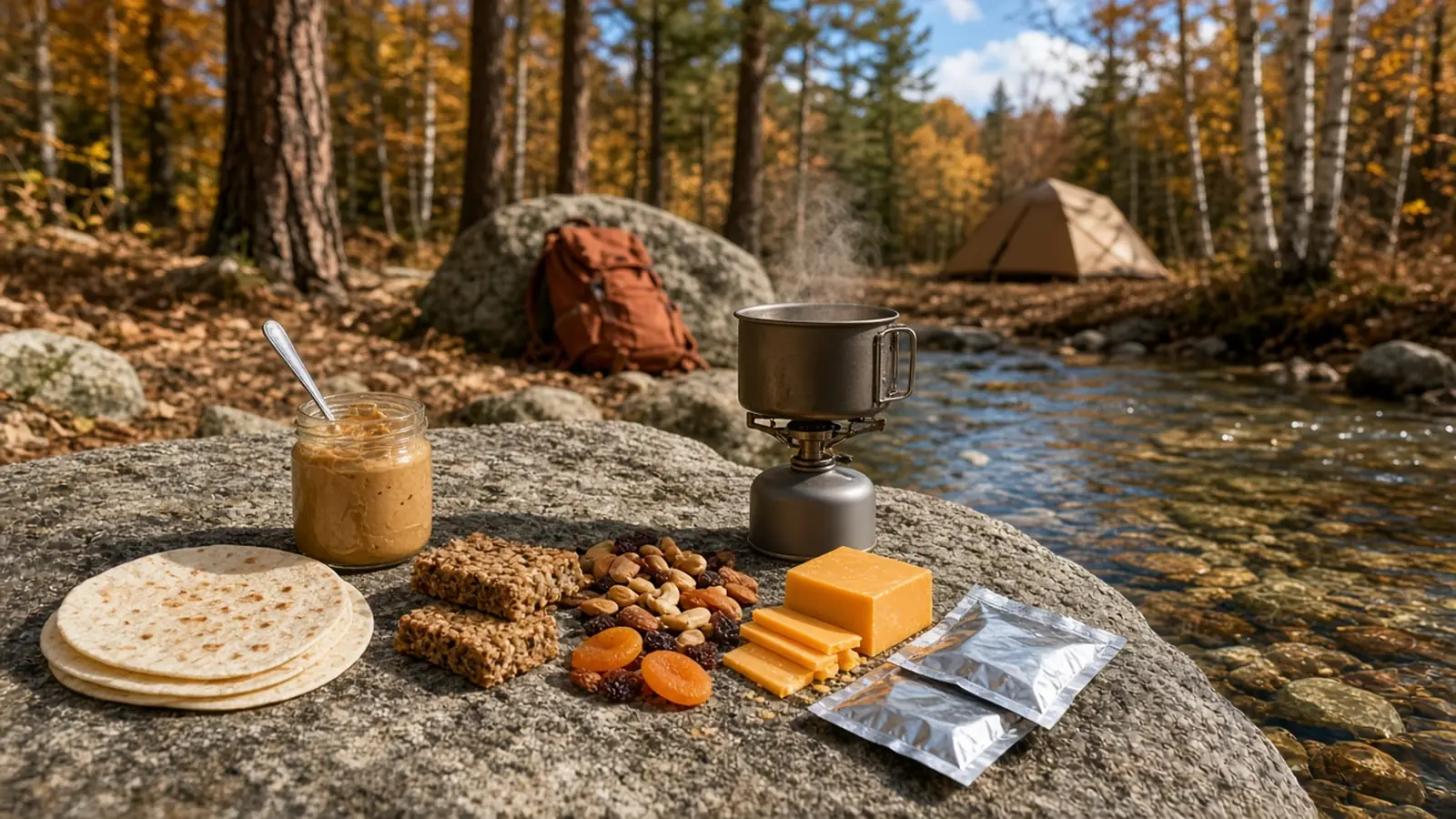
The short answer: REI calls about 2,500 to 4,500 calories, or roughly 1.5 to 2.5 pounds of food, per person per day “a reasonable goal.” Where you land in that range depends on your miles, climbing, body size and conditions. To keep the weight down, REI suggests choosing foods with at least 100 calories per ounce, and says 125 or more is even better.
To turn that range into a number for your own trip, use the free Clever Trail Fuel Planner. Enter your distance, elevation gain and number of days, and it estimates the calories you need. It then tracks your food bag’s weight and calories per ounce as you pack.
Why the range is so wide
REI’s own example makes the point: someone doing 10 miles of strenuous hiking with a 4,000-foot climb will burn more calories, and need more food, than someone covering a few flat miles before relaxing at camp. REI lists the factors that matter as the intensity of your activity, your size and weight, how many calories you burn, and how many days you’ll be out.
So calories per day backpacking isn’t one figure. It’s a budget built from three things:
- What your body uses anyway, including camp time, sleep and digestion.
- How far you walk.
- How much you climb.
The figures to start from
| Guideline | Figure | Source |
|---|---|---|
| Calories per person per day | About 2,500–4,500 | REI, Backpacking Food Ideas & Meal Planning |
| Food weight per person per day | About 1.5–2.5 lb | REI, Backpacking Food Ideas & Meal Planning |
| Calorie density to aim for | At least 100 calories per ounce; 125+ is even better | REI, Meal Planning for Ultralight Backpacking |
REI also suggests erring on the side of a little more food, since extra food is one of the Ten Essentials for an overnight trip. It warns against packing so much that you haul unwanted bulk, though. Experience narrows it down.
How the Clever Trail Fuel Planner works out calories per day
The Clever Trail Fuel Planner uses a simple, editable formula:
Daily target = camp baseline + (miles per day × calories per mile) + (feet of climbing per day ÷ 1,000 × calories per 1,000 ft)
It uses your average miles and elevation gain per day, and adds up the days for a trip total. The defaults are:
| Setting | Default |
|---|---|
| Camp baseline (sleep, digestion, camp chores) | 1,600 calories |
| Calories per mile | 110 |
| Calories per 1,000 ft of climbing | 165 |
Under Calorie Formula Tuning, you can switch to a preset profile or type your own numbers:
| Profile | Baseline | Per mile | Per 1,000 ft |
|---|---|---|---|
| Ultralight Cruiser | 1,500 | 90 | 250 |
| Standard Pack | 1,800 | 110 | 300 |
| High-Output Grinder | 2,200 | 140 | 400 |
These are planning settings, not measurements of your body. Pick the profile that feels closest, then adjust it after a trip or two.
Three example days (default formula)
| Day | Calculation | Daily target |
|---|---|---|
| 8 miles, 1,000 ft gain | 1,600 + 880 + 165 | 2,645 calories |
| 12 miles, 2,500 ft gain | 1,600 + 1,320 + 412.5 | about 3,330 calories |
| 20 miles, 4,000 ft gain | 1,600 + 2,200 + 660 | 4,460 calories |
All three land inside REI’s 2,500–4,500 range. Switch the profile and the same 12-mile day ranges from about 3,200 calories (Ultralight Cruiser) to about 4,880 (High-Output Grinder). That’s why the planner lets you tune the formula.
The planner also shows an Energy Miles Equivalent, which counts climbing as extra flat miles. With the defaults, every 1,000 feet of gain counts as 1.5 extra miles (165 ÷ 110).
Calories per ounce: the lever that sets food weight per day
Once you know your calorie target, food weight per day = calories ÷ calories per ounce. Small changes in density add up fast:
| Daily target | At 100 cal/oz | At 110 cal/oz | At 125 cal/oz | At 130 cal/oz |
|---|---|---|---|---|
| 3,000 calories | 30 oz (1.9 lb) | about 27 oz (1.7 lb) | 24 oz (1.5 lb) | about 23 oz (1.4 lb) |
| 3,500 calories | 35 oz (2.2 lb) | about 32 oz (2.0 lb) | 28 oz (1.75 lb) | about 27 oz (1.7 lb) |
Over a five-day trip at 3,500 calories a day, going from 100 to 125 calories per ounce saves 35 oz, a bit over 2 pounds.
The Clever Trail Fuel Planner rates your whole food bag’s Caloric Density. Below 110 calories per ounce is flagged as low, 110 or more is labeled Good, and 130 or more is Elite. That’s slightly stricter than REI’s 100 cal/oz floor. As the tool itself puts it, density “measures food efficiency only, not whether your total calories match your trip needs.”
Which foods are dense?
REI’s examples of calorie-dense foods include: – nuts and nut butters – seeds – dried fruit – hard cheeses, jerky and dry salami – energy bars – oils, powdered butter, powdered milk or protein powder added to meals
The planner’s quick-add list shows the same pattern. Using the planner’s own built-in values, olive oil works out to about 250 calories per ounce, macadamia nuts about 200 and peanut butter 160, while a 3-oz foil packet of tuna is about 33 cal per ounce. Those quick-add values are planning estimates, so check your own food labels.
Density isn’t everything. REI also recommends balancing carbohydrates, proteins and fats, and bringing foods you actually like to eat.
Using the Clever Trail Fuel Planner, step by step
- Trip Identity: add a trip name, season and expected low, or pick a trail from Pre-Built Famous Trail Sections to fill in the route numbers.
- Trip Parameters: set Distance (Miles), Elevation Gain (ft) and Number of Days (up to 30).
- Build Your Food Bag: choose a quick-add item or enter your own food, calories and weight, then tap Add to Pack.
- Trip Fuel Analysis: compare Target Calories Needed with what you’ve packed. Calorie Gap shows how far over or under you are, and Actionable Pick suggests calorie-dense foods to close a gap.
- Daily Carry Breakdown: see the calories and ounces of food planned for each day.
Your plan saves in your own browser on that device. Copy Share Link puts the whole plan into a link you can share. It’s free, with no account needed.
Practical tips for packing the right amount
- Plan each day, not just the trip total. Big climbing days need more. The Daily Carry Breakdown makes uneven days easy to spot.
- Raise density before cutting calories. Swapping bulky items for oils, nuts or nut butters lowers weight without shrinking the calorie budget.
- Carry a small extra. REI recommends a little extra food, in line with the Ten Essentials.
- Repackage. REI suggests moving food into resealable pouches to cut bulk and trash.
- Plan water alongside food. Dehydrated meals need water to cook, so check your water plan too. Our guide How Much Water Per Day Backpacking? covers the figures, and the free Clever Water Trip Planner does the math.
- Food is a consumable. It isn’t part of base weight, but it can be one of the heaviest things you carry. Our Ultralight Base Weight Guide explains the split.
A short health note
Calorie targets from any calculator, including ours, are estimates. Appetite, body size, pace, temperature and health all change what you need. If you have diabetes, food allergies, a medical condition or a special diet, talk to a registered dietitian or your doctor before a long trip. On the trail, pay attention to hunger and energy levels and adjust.
Plan your food bag
So, how much food per day backpacking? Start with REI’s 2,500–4,500 calories (about 1.5–2.5 lb), aim for at least 100 calories per ounce, and then make it personal. The free Clever Trail Fuel Planner turns your miles, climbing and days into a calorie target. As you pack, it shows your food weight, caloric density and any gap to close.