How Much Water Per Day Backpacking?
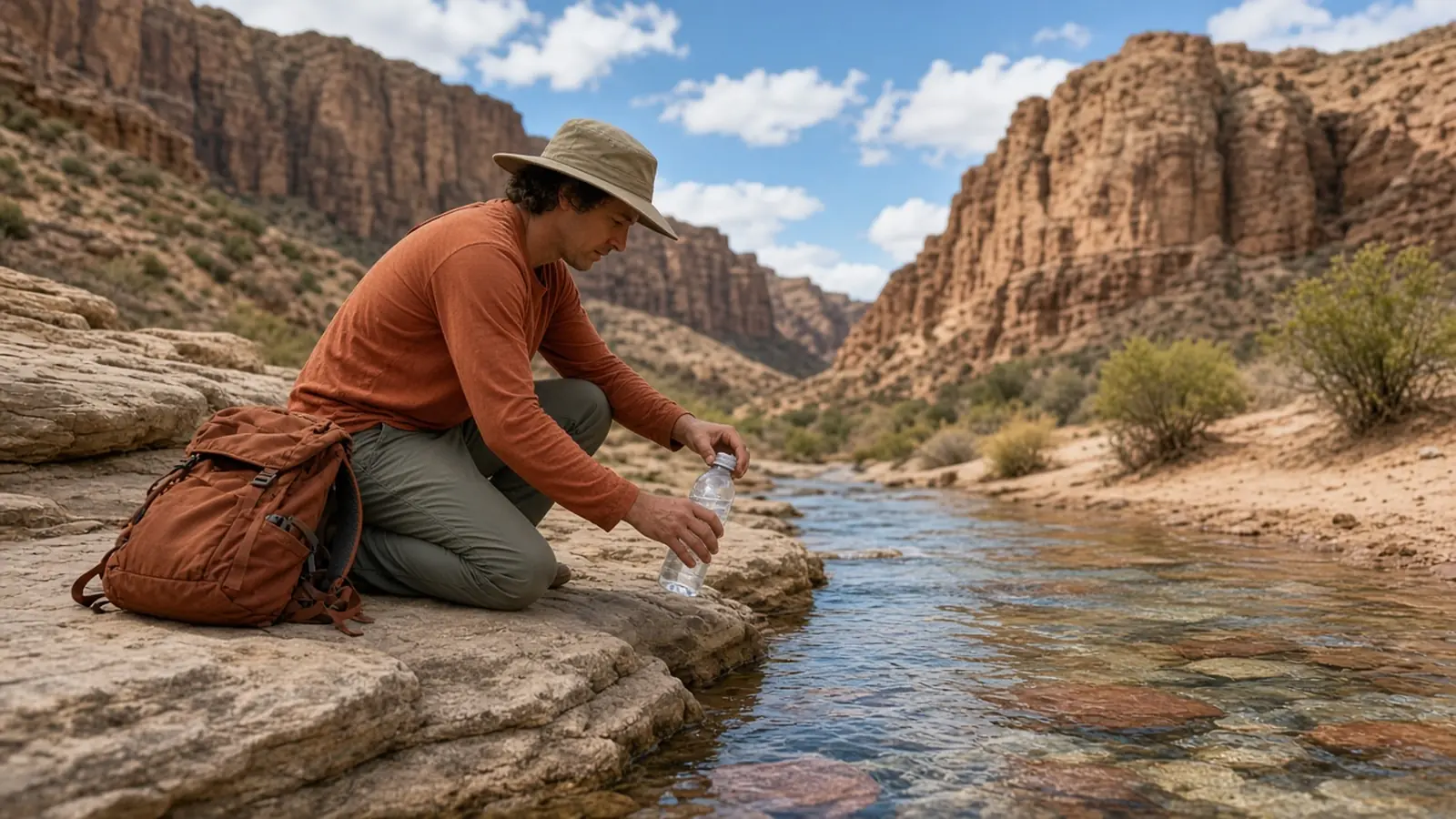
The short answer: there’s no single daily number, because water needs depend on heat, effort, terrain and your body. Most guidance works by the hour instead. REI suggests about half a liter per hour of moderate activity in moderate temperatures, and a liter or more per hour for strenuous hiking in high heat. In hot desert parks, the National Park Service’s minimum is higher still: Big Bend recommends at least a gallon per person per day in summer, and Mojave says hikers should carry two gallons per person per day.
You don’t usually need to carry a full day’s water, though. You need enough to reach the next reliable source, plus a margin. To work that out for a specific stretch, use the free Clever Water Trip Planner: enter the distance, terrain and weather, and it estimates how much water to carry, what it weighs, and whether your bottles hold enough.
Why “per day” is the wrong starting point
A day of backpacking might include three hours of cool morning walking, a hot exposed climb at noon, and an evening at camp. Each part burns through water at a different rate. REI lists the main factors: the activity, intensity, duration, weather, your age, your sweat rate and your body type. That’s why both REI and the NPS give ranges and minimums, not one figure for everyone.
A more useful question is: how much water do I need between here and the next reliable source? That depends on three things:
- How long you’ll be walking (distance ÷ your pace).
- How fast you’ll drink in those conditions (liters per hour).
- What you need at camp if you’ll cook or sleep before the next source.
Hourly guidelines: the numbers to start from
| Situation | Guideline | Source |
|---|---|---|
| Moderate activity, moderate temperatures | About 0.5 L per hour | REI |
| Strenuous hiking in high heat | 1 L or more per hour | REI |
| Desert parks (Big Bend), summer | At least 1 gallon (about 3.8 L) per person per day | NPS, Big Bend National Park |
| Desert hiking (Mojave) | Hikers should carry 2 gallons (about 7.6 L) per person per day | NPS, Mojave National Preserve |
| Moderate activity in the heat, under 2 hours | 1 cup (8 oz) every 15–20 minutes | CDC / NIOSH workplace heat guidance |
| Upper limit | “Generally, fluid intake should not exceed 6 cups per hour” (that’s 48 oz, about 1.4 L, by our conversion) | CDC / NIOSH workplace heat guidance |
The CDC figures come from workplace heat guidance, not hiking advice, but it’s a useful reminder that more isn’t always better (see the safety note below).
How much water to carry backpacking: per mile
Per-mile figures make planning a dry stretch much easier. The math is simple: liters per mile = liters per hour ÷ miles per hour.
The Clever Water Trip Planner uses these base rates and paces:
| Weather setting | Base rate | Terrain setting | Pace | |
|---|---|---|---|---|
| Cool / Mild (under 65°F) | 0.4 L/hr | Flat / Easy | 2.5 mph | |
| Warm (65–80°F) | 0.6 L/hr | Rolling Hills | 2.0 mph | |
| Humid / Muggy | 0.75 L/hr | Exposed Desert Road | 2.2 mph | |
| Hot / Exposed (over 80°F) | 0.9 L/hr | Strenuous / Steep / Rocky | 1.4 mph |
So, before any adjustments:
- Cool, flat ground: 0.4 ÷ 2.5 = about 0.16 L per mile.
- Warm, rolling hills: 0.6 ÷ 2.0 = 0.3 L per mile.
- Hot, exposed desert: 0.9 ÷ 2.2 = about 0.41 L per mile.
For comparison, REI’s general guide is about 0.5 L per hour of moderate activity in moderate temperatures, rising to 1 L or more per hour for strenuous hiking in high heat.
How the Clever Water Trip Planner adjusts the estimate
The planner doesn’t stop at the base rate. It:
- Scales for body weight against a 160 lb baseline hiker, capped between 0.8x and 1.4x (body weight is optional; it assumes 160 lb if you leave it blank).
- Adds a camp buffer for cooking and drinking at camp (500 ml by default; you can change it).
- Adds 10% if you tick High Altitude (hiking consistently above 8,000 feet).
- Adds a 15% safety buffer, then rounds up to the next half liter.
It then checks your selected bottles against the total. It flags a shortfall, more than a liter of spare capacity, or a carry of 4 liters or more.
Three worked examples
These use the planner’s formula with its defaults: 160 lb hiker, 500 ml camp buffer, no altitude adjustment.
| Stretch | Hours | Water to carry | Water weight |
|---|---|---|---|
| 8 miles, flat, cool | 3.2 | 2.5 L | about 5.5 lb |
| 10 miles, rolling hills, warm | 5.0 | 4.5 L | about 9.9 lb |
| 12 miles, exposed desert, hot | about 5.5 | 6.5 L | about 14.3 lb |
The desert example shows why dry stretches dominate pack weight. Run your own numbers in the Clever Water Trip Planner. It also has presets for well-known dry sections on the PCT, CDT, AZT and other trails.
Water weight: why it matters so much
A liter of water weighs about 1 kilogram (about 2.2 pounds). The USGS gives water’s density as roughly 1 gram per milliliter. NIST’s conversion tables put 1 kilogram at 2.204 623 pounds, and 1 US gallon at 3.785 liters.
| Amount | Approximate weight |
|---|---|
| 0.5 L | 1.1 lb |
| 1 L | 2.2 lb |
| 2 L | 4.4 lb |
| 1 gallon (3.8 L) | 8.3 lb |
| 2 gallons (7.6 L) | 16.7 lb |
For comparison, many ultralight hikers aim for a base weight under 10 lb (see our Ultralight Base Weight Guide). A two-gallon desert carry can weigh more than the rest of the kit. Water counts as a consumable, so it isn’t part of base weight, but your shoulders still feel it.
Desert water needs
Deserts change the math in three ways: higher hourly rates, faster walking on open roads, and long gaps between sources. The NPS guidance for desert parks is blunt:
- Big Bend National Park recommends carrying a minimum of one gallon of water per person per day in summer (slightly less in winter). For half-day hikes, it says to carry at least 2 quarts (2 liters) per person. It also warns that springs and tinajas are unreliable.
- Mojave National Preserve recommends a minimum of one gallon per person per day, and says hikers and cyclists should carry two gallons per person per day.
In the Clever Water Trip Planner, choosing Exposed Desert Road terrain sets the hot 0.9 L per hour rate, whatever weather you pick. Local park and trail guidance always comes first. Check current water reports and ranger advice before any desert trip.
Practical ways to carry less (safely)
- Drink at the source. Drinking at a reliable source means less water to carry out of it. The planner suggests 0.5 L, or 0.75–1 L when the next leg needs 3 L or more.
- Plan around sources, not days. Break a trip into legs between reliable sources and plan each leg separately.
- Walk in the cool hours. Big Bend’s heat guidance advises avoiding low-elevation hiking during the heat of the day in the hottest months. Cooler hours mean a lower hourly rate.
- Match bottles to the need. Carrying a liter or more of empty capacity you don’t need adds weight; the planner flags this.
- Treat what you collect. REI notes that filtering and treating water from streams and lakes lets you refill and carry less.
A short safety note
This article is general planning information, not medical advice. Everyone’s needs differ, so use these figures as a starting point.
- Don’t ration water you’re carrying. Big Bend’s guidance is to drink your available water rather than trying to conserve it.
- Don’t overdo it either. REI warns that drinking too much can lead to hyponatremia (low blood sodium) and suggests about 10 fl oz every 20 minutes. CDC workplace heat guidance says, “Generally, fluid intake should not exceed 6 cups per hour” (48 oz, about 1.4 L, by our conversion).
- Replace electrolytes on long, sweaty days. REI suggests snacks with sodium and potassium on outings longer than about an hour, and an electrolyte sports drink for extended, high-intensity activity. CDC workplace heat guidance recommends sports drinks with balanced electrolytes if sweating lasts several hours.
- If you have a medical condition, or take medication that affects fluid balance, ask your doctor how much to drink.
Plan your next dry stretch
The answer to “how much water per day backpacking” is really “it depends”, but you can turn that into a number for each leg of your trip. Open the Clever Water Trip Planner, enter your distance, terrain and weather, and it shows how much to carry, what it weighs, and whether your bottles are up to it. It’s free, with no account needed. For the food side of the same trip, the Clever Trail Fuel Planner does the same job for calories.