Sierra Designs Cloud 20°F Review: Zippered vs. Zipperless
This Sierra Designs Cloud 20 review covers both versions of the bag sold today: the Sierra Designs Cloud Zipperless 800F 20°, the original design with a wrap-over comforter and pad sleeve, and the newer Sierra Designs Cloud Zippered 800F 20°, a conventional mummy with a zipper. Almost every existing review covers only the zipperless bag, so this one focuses on choosing between them. For bag basics, see our guide on how to choose a backpacking sleeping bag.
Methodology: This review is research-based. Specs and comparisons come from Sierra Designs’ published data and independent reviews, not our own measurements.
Disclosure: No affiliate links here, and Sierra Designs gave us nothing. Clever Backpacking’s only cash income is reader donations and gear sold in our own shop. A Zpacks referral banner elsewhere on the site earns us points toward discounted Zpacks gear (not cash).
Quick verdict: which Cloud 20 should you get?
Pick the Cloud Zipperless if you want quilt-like freedom with no zipper and you’ll always sleep with an insulated pad in its sleeve. Pick the Cloud Zippered 800F 20° if you want a conventional mummy with a zipper and draft collar that vents by unzipping. Either way, treat “20°F” as a limit-range number.
Key takeaways
- The zipperless is for zipper-haters who always carry a warm pad. It has a comforter, hand pockets, a foot vent, and a pad sleeve.
- The zippered is for restless sleepers who want a familiar closed mummy with a draft collar.
- Warmth caveat: ISO comfort is 28°F (zippered) and 26°F (zipperless), both above 20°F, and OutdoorGearLab’s testers called the zipperless ratings generous.
- Foot vent on both: in our view, a standout feature. Hot feet can cool off without unzipping or opening the bag.
- Pad dependency: the zipperless has no down under your torso, so your pad does all the insulating there.
- Price and weight are close: $239.95 each, 1.94 lb vs. 2 lb. Design is the real decision.
How we reviewed the Cloud 20
This review is research-based for both versions. Performance claims for either bag are attributed to their source. Specs come from Sierra Designs’ product pages; observations come from named independent reviews. Citations are in Sources.
Sierra Designs Cloud 20 specs: zippered vs. zipperless (Regular)
Per Sierra Designs (as of Sept 2026). Sierra Designs doesn’t say whether its weights are trail or packed weights.
| Spec (Regular) | Cloud Zippered 800F 20° | Cloud Zipperless 800F 20° |
|---|---|---|
| ISO comfort | 28°F (-2.2°C)* | 26°F (-3.3°C) |
| ISO limit | 17°F (-8.3°C) | 15°F (-9.5°C) |
| Weight | 1.94 lb / 0.88 kg | 2 lb / 0.91 kg |
| Fill weight | 14.74 oz / 418 g | 14.8 oz / 420 g |
| Fill power / type | 800-fill hydrophobic DriDown | 800-fill DriDown (“responsibly sourced”) |
| Shell / liner | 15D 400T nylon ripstop (liner listed as recycled) | 15D 400T nylon ripstop |
| Closure | Zipper (length not given on the product page) | Zipperless comforter with insulated hand pockets |
| Pad integration | Pad loops; aftermarket straps needed, not included | Rear pad sleeve |
| Underside insulation | Not stated by Sierra Designs | None from waist to shoulders |
| Baffle construction | Box baffle, 5 in spacing | “Baffled” |
| Foot vent | Self-sealing | Self-sealing |
| Fits-to height / length | 6 ft / 78 in | 6 ft / 78 in |
| Shoulder / hip / foot girth | 62 / 58 / 40 in | 62 / 60 / 40 in |
| Packed size | 7.5 × 7.5 × 16 in | 7.5 × 7.5 × 16 in |
| MSRP | $239.95 | $239.95 |
| Long size | $249.95; 2.06 lb; 16.33 oz fill; fits 6 ft 6 in | $249.95; 2.17 lb; 16.4 oz fill; fits 6 ft 6 in |
Sierra Designs prints “28F / 3.3C”; 28°F is -2.2°C. The 2018 zipperless model was listed at 1 lb 13–15 oz; Sierra Designs doesn’t explain the difference.
Naming: Sierra Designs’ current store titles are “Cloud Zippered 800F 20 Deg Sleeping Bag” and “Cloud Zipperless 800F 20 Deg Sleeping Bag Green.” Older reviews and retailers call the zipperless bag the “Cloud 800 20” or “Cloud 20.”
Zip vs. zipperless: the real differences
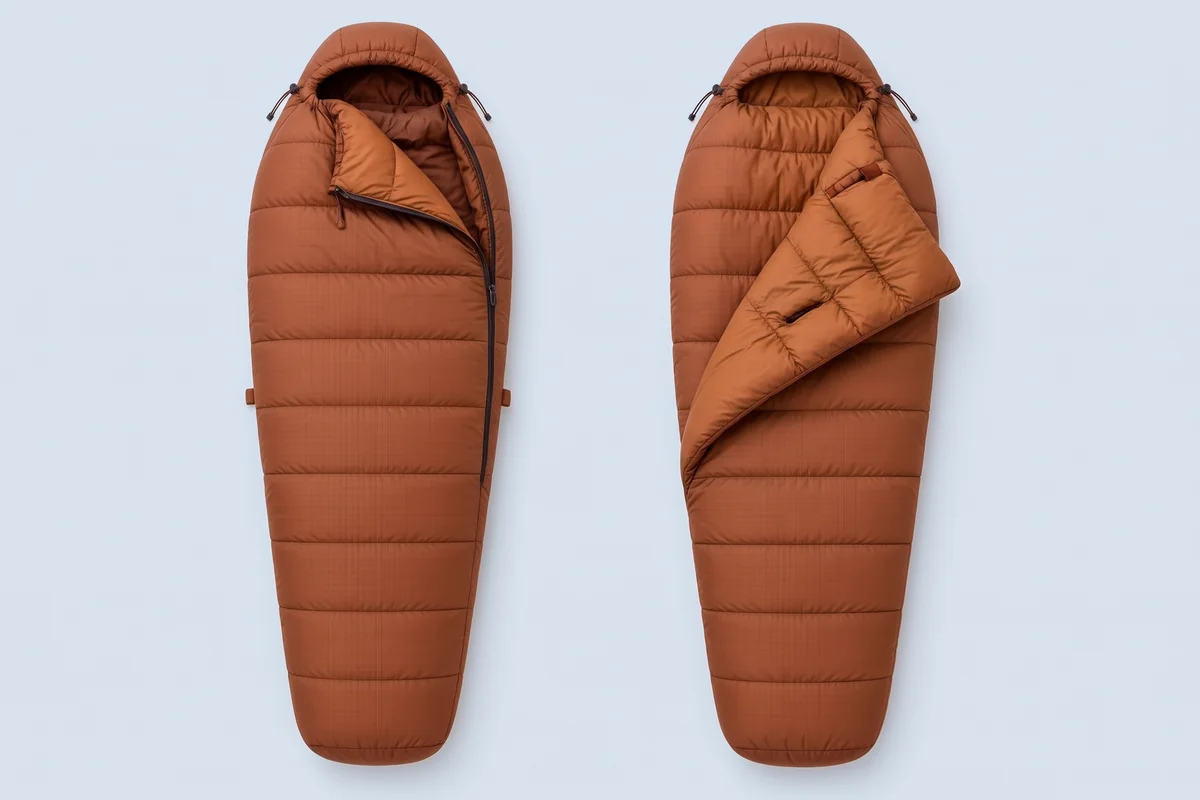
The two bags share a name, 800-fill DriDown, and a self-sealing foot vent, but little else. The zipperless sleeping bag is a hybrid of a mummy and a top bag: a sleeping bag with a pad sleeve, so the pad insulates your back. Skurka notes the comforter is detached on the sleeper’s left, with no underside insulation from waist to shoulders. The zippered bag, in Sierra Designs’ words, brings “the classic mummy shape back at an impressively low weight.”
Getting in, getting out, and venting
With the zipperless, you open the comforter and slide in. Live For The Outdoors says the big comforter overlap keeps drafts out, and T3 found it easy to throw aside when warm.
For your legs, both versions use the foot vent, a slit you push your feet through. In our view, it’s one of the main reasons to like this bag. If your feet run hot, a standard mummy makes you unzip to cool them; the Cloud’s vent lets you air out just your feet. The Trek’s reviewer said it let her regulate heat better than any other mummy bag she’d encountered. OutdoorGearLab found it weak for venting.
The zippered version vents the conventional way, by unzipping, plus the same foot vent. The product page doesn’t give the zipper’s length; Sierra Designs’ Amazon listing calls it a full zip.
Drafts, sealing, and cold nights
This is where reviewers diverge most. TGO Magazine’s reviewer found it “draughty” in the night and got tangled in the flap. OutdoorGearLab reported that the hood only stays cinched if the flap stays pinned under your left shoulder, which is hard on your right side.
Not everyone had problems. The Trek’s reviewer “never experienced a draft,” and Skurka expected drafts to be “minimal or non-existent” because the comforter hooks around the shoulder and overlaps the side insulation.
On paper, the zippered version addresses these concerns with a Draft Dodger collar and 5-inch sidewall baffles, per Sierra Designs. We found no independent draft testing of it.
Weight and what the zipper costs you
The original Cloud cut the zipper and bottom insulation to save weight, yet current listings put the two Regulars close: zippered 1.94 lb vs. zipperless 2 lb. Older zipperless listings ran 1 lb 13–15 oz.
Durability and snag points (zipper vs no zipper)
The zipperless bag has no zipper to snag or fail. The trade-off is a permanent pad sleeve.
Sierra Designs counters on the zippered version with “anti-snag zipper construction”; we found no independent long-term data on it. Both use 15-denier nylon ripstop for the shell and liner.
Who each version is for
Choose the Cloud Zipperless if…
- You’re tired of zipper snags and like the idea of a bed-style comforter.
- You sleep on your back or side and want a blanket feel. Some reviewers found the flap and hood work best on your back or left side.
- You always carry an insulated pad that fits the sleeve and will never use the bag without one.
- You vent a lot on mild nights.
Choose the Cloud Zippered if…
- You toss and turn, sleep on your right side, or want a bag that stays sealed without being tucked in.
- You sometimes sleep without a pad, such as on a hut bunk.
- You want a draft collar and conventional zipper venting.
- You’d rather add optional pad straps than commit to a fixed sleeve.
Skip both if…
- You’re a true cold sleeper and want to be comfortable at 20°F. Both bags’ ISO comfort ratings (28°F and 26°F) sit above that.
- You won’t carry a well-insulated pad. The zipperless depends on one, and any ISO-rated bag assumes one.
- You count every gram. A quilt, such as the 1.69 lb Cloud Quilt, saves weight.
Comfort, sleeping positions, and the pad sleeve
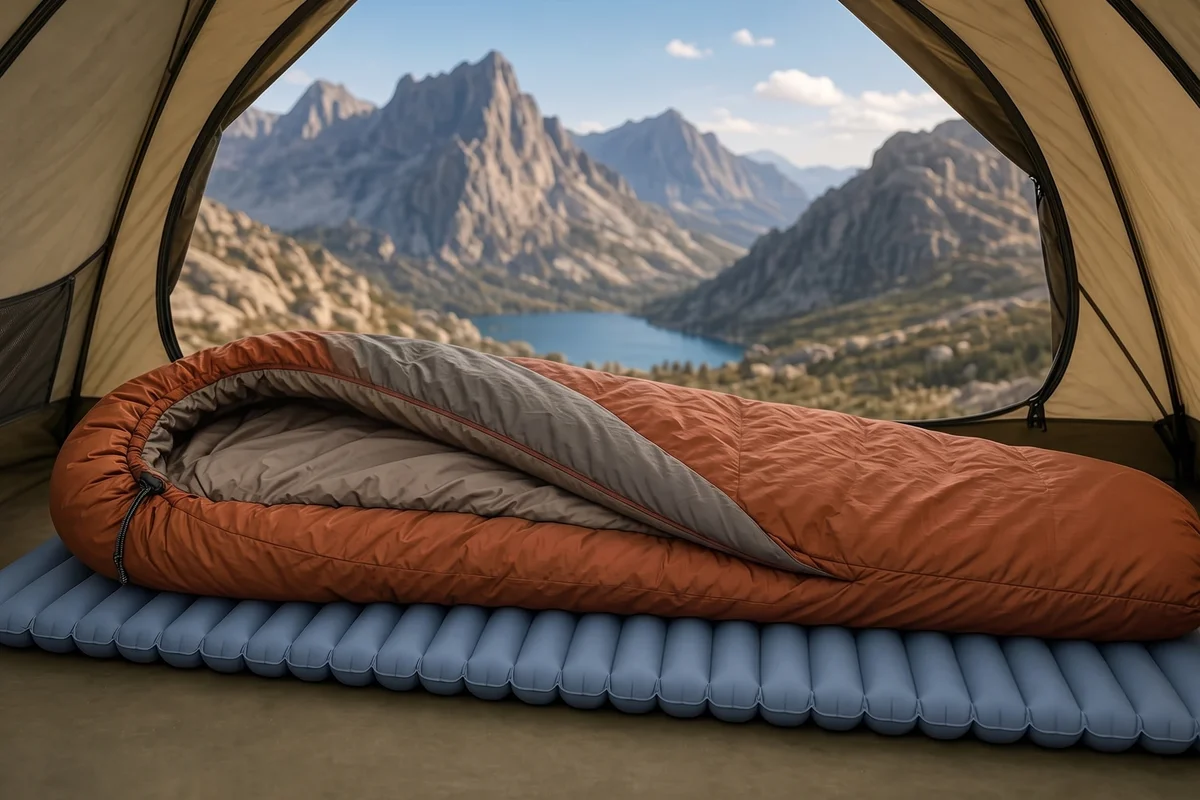
How the zipperless comforter and pad sleeve work
The zipperless Cloud works like a top bag. Down you lie on gets crushed and adds little warmth, so Sierra Designs leaves it out under your torso and adds a pad sleeve instead. OutdoorGearLab photographed light shining through the “uninsulated rectangle” on the underside and called a good pad “mandatory.”
Reviewers liked that it keeps you on your pad. A Trailspace user noted your pillow must go inside the hood.
Side sleepers and restless sleepers
In our view, the Cloud 20 paired with a thick, well-insulated pad is a good pick for side sleepers. That’s opinion, not a test finding.
A bag that doesn’t roll with you can be a plus for side sleepers. You turn inside it instead, so a side zipper stays where you can reach it rather than ending up underneath you. That works best when the bag is strapped to the pad. The Cloud Zippered 800F 20° has pad loops, but Sierra Designs doesn’t include straps.
Sierra Designs markets the zipperless as “Designed for side sleepers and hot sleepers alike.” The Trek’s reviewer (2017, donated sample) agreed, calling it good for side sleepers after sleeping on her left side with the comforter tucked in.
Most other testers preferred it for back sleeping. Skurka’s one criticism was side sleeping: his face ended up facing the side of the bag. OutdoorGearLab’s Cloud 20 tester struggled to keep the flap pinned on the right side, and its Cloud 35 review says it works best for back sleepers. T3 says it may not suit side sleepers; SectionHiker found side sleepers likely to pull the coverlet aside. The pattern: because the comforter opens on the sleeper’s left, right-side and restless sleepers struggle most. No independent review covers the Zippered.
Pairing the Cloud 20 with a pad: NEMO Eclipse All-Season example
The zipperless Cloud has no insulation under your back from waist to shoulders, so the pad does it. The Cloud Zippered 800F 20° has pad loops for aftermarket straps (not included).
Take the NEMO Eclipse All-Season Regular: 72 × 20 × 4.0 in and R 6.2, per NEMO. Sierra Designs recommends no R-value; T3 got cold near freezing on an R 2.1 mat and did better on R 4.2, so R 6.2 should be ample.
The last published Regular sleeve spec (older model, via T3) fits a 20 × 2.5 in pad, 45.5 in around; a 20 × 4 in Eclipse needs about 48 in. Check the sleeve against your pad first.
We like that the Eclipse comes in Regular, Regular Wide and Long Wide, so you can pick one that fits your body. The 25-inch sizes won’t fit the zipperless Regular sleeve (Skurka doubted a 25-inch pad works), but the Regular Wide works with the Cloud Zippered 800F 20° plus straps.
In our view, both the Cloud 20 and the NEMO Eclipse are good picks for side sleepers. Both Cloud versions have 62 in shoulders, versus the Western Mountaineering UltraLite’s 59 in. On a 1- to 2-inch pad, a side sleeper’s hips can bottom out and lose support. We like the Eclipse’s 4 inches for keeping hips off the ground, and we think it gives heavier sleepers more support, though Treeline Review‘s testers found it could be more supportive for heavier side sleepers. See our NEMO Eclipse All-Season review.
Warmth: what the 20°F rating actually means (ISO/EN)
Comfort vs. limit rating
The ISO 23537 figures (successor to EN 13537) mean more than the “20°F” name. Per SectionHiker:
- Comfort is the lowest temperature at which a “standard” woman, lying relaxed, stays comfortable and not cold.
- Limit (lower limit) is the lowest temperature at which a “standard” man, curled up, can sleep without shivering. It’s not a comfort promise.
Both assume a base layer, socks, and a rated pad. Sierra Designs lists 28°F comfort / 17°F limit for the zippered and 26°F / 15°F for the zipperless. Cold sleepers should plan around the comfort figure. Our guide explains comfort vs. limit ratings.
What independent reviewers reported
- TGO Magazine found it warm on chilly nights, except when drafts got in.
- T3 got cold near freezing on a low-R-value pad, blamed the pad rather than the bag, and said a warmer pad greatly extended the bag’s range.
- The rating feels optimistic to some. OutdoorGearLab felt the zipperless performed like a bag with about a 25°F limit, not 15°F. Two r/Ultralight owners reported getting cold around the mid-30s (2020, 2025).
We found no independent warmth testing of the current Cloud Zippered 800F 20°.
What other reviewers say
Every independent review we found covers the zipperless Cloud (2017–2024); none covers the Cloud Zippered 800F 20°.
- Andrew Skurka (zipperless Cloud 35 and 20; his eight-night trip was in the 35): Praised it as less restrictive than a mummy, with no snag-prone zipper and adjustable girth, performing like a mummy when closed up. His one criticism was side sleeping: the bag doesn’t turn with you, so his face ended up facing the side of the bag.
- OutdoorGearLab (zipperless Cloud 20, 2019): Liked the easy closure and foot vent, and credited it with wider-than-average dimensions, yet found it about as confining as other mummies and less roomy than the Backcountry Bed. It found the hood drafty and the lower-body venting weak. It also disliked that the uninsulated pad sleeve can’t be removed. And it felt the ratings were generous, like a bag with about a 25°F limit.
- T3 (zipperless 20°F, 2023): Praised the room to move, the warmth-to-weight ratio, the zipperless design, and the foot vent. It says the bag may not suit side sleepers. It also says the bag needs a warm pad.
- Wilderness Magazine (zipperless Cloud 20, 2020): Rated it a lightweight, warm bag with great ventilation. It notes the bag works best with a sleeping mat. It adds that the zipperless design may limit versatility.
- The Trek (zipperless Cloud 20, 2017, donated sample): Called its heat regulation the best of any mummy the reviewer had encountered, and found it good for side sleepers. Its main con is that the thin, uninsulated back panel is noticeable on a foam pad.
- Long-term owners: two report down leaking at the seams after years: a Skurka commenter (Cloud 35) and a Backpacking Light forum member (Cloud 20, bought 2018).
Packability and base weight
Sierra Designs lists 7.5 × 7.5 × 16 in packed for both Regulars. It lists a stuff sack and storage bag for the Zippered; its Amazon listing shows a stuff sack for the zipperless. OutdoorGearLab and TGO both found the stuff sack poor at compressing the bag; TGO liked the mesh storage sack.
The two Regulars are listed at 1.94 lb and 2 lb, so weight shouldn’t decide. See how sleep-system ounces affect your base weight. You can also add both versions to Pack Builder and compare against the rest of your gear.
Alternatives to the Cloud 20
Common alternatives, not ranked; figures come from their makers.
| Option | Type | Closure | Fill | Weight | Rating |
|---|---|---|---|---|---|
| Sierra Designs Cloud Quilt 800F 20° | Quilt/bag hybrid | Comforter over upper body, footbox, hideaway hood | 800 DriDown, 14.78 oz | 1.69 lb | ISO 32°F comfort / 21°F limit |
| Sierra Designs Backcountry Bed 20 | Zipperless bag | Comforter with insulated hand/arm pockets, pad sleeve | 650 DriDown, 20.6 oz | 2 lb 6.4 oz | ISO 28°F comfort / 16°F limit |
| Feathered Friends Tanager 20 | Hoodless, zipperless ultralight bag | Pullover | 950+ goose down, 12.7 oz | 18.9 oz | 20°F (maker rating) |
| Western Mountaineering UltraLite 20°F | Conventional mummy | Full zip with draft tube | 850+ down, 16 oz | 1 lb 13 oz | 20°F (maker rating) |
Prices per makers, Sept 2026: Cloud Quilt $199.95; Backcountry Bed $209.95; Tanager $489–$559; UltraLite $660–$705.
- Cloud Quilt: the comforter idea taken further toward a blanket.
- Backcountry Bed 20: a roomier zipperless comforter, heavier and cheaper; OutdoorGearLab preferred its closure.
- Feathered Friends Tanager 20: for gram-counters with a hooded down jacket.
- Western Mountaineering UltraLite 20°F: a lighter full-zip mummy at a much higher price.
To filter options by weight and temperature, try our Clever Gear Finder.
Related reading
Sources
- Sierra Designs, Cloud Zippered 800F 20 Deg Sleeping Bag: https://sierradesigns.com/products/cloud-zip-800f-20-deg-sleeping-bag
- Sierra Designs, Cloud Zipperless 800F 20 Deg Sleeping Bag Green: https://sierradesigns.com/products/cloud-800f-20-deg-sleeping-bag-green
- Sierra Designs, Cloud Quilt 800F 20 Deg Sleeping Bag Reg: https://sierradesigns.com/products/cloud-quilt-800f-20-deg-sleeping-bag-reg
- OutdoorGearLab, Sierra Designs Cloud 20 Review (Jack Cramer, 2019): https://www.outdoorgearlab.com/reviews/camping-and-hiking/backpacking-sleeping-bag/sierra-designs-cloud-20
- Andrew Skurka, Review: Sierra Designs Cloud 35 & 20 (2018): https://andrewskurka.com/review-sierra-designs-cloud-35-20-zipperless-mummy/
- T3, Sierra Designs Cloud review: https://www.t3.com/reviews/sierra-designs-cloud-800-20-review
- TGO Magazine, Sierra Designs Cloud review: https://www.thegreatoutdoorsmag.com/review/sierra-designs-cloud-800-20/
- Wilderness Magazine (NZ), Sierra Designs Cloud 20 Sleeping Bag Review: https://www.wildernessmag.co.nz/review/sierra-designs-cloud-20-sleeping-bag-review/
- The Trek, Gear Review: Sierra Designs’ Cloud 20ºF Sleeping Bag: https://thetrek.co/gear-review-sierra-designs-cloud-20of-sleeping-bag/
- Trailspace, Sierra Designs Cloud user reviews: https://www.trailspace.com/gear/sierra-designs/cloud-80020-degree/
- SectionHiker, How Do Sleeping Pad R-Values Affect Sleeping Bag Temperature Ratings?: https://sectionhiker.com/sleeping-pad-r-values-sleeping-bag-temperature-ratings/
- SectionHiker, Sierra Designs Cloud 35 Sleeping Bag Review: https://sectionhiker.com/sierra-designs-cloud-35-sleeping-bag-review/
- OutdoorGearLab, Sierra Designs Cloud 800 35 Review: https://www.outdoorgearlab.com/reviews/camping-and-hiking/ultralight-sleeping-bag/sierra-designs-cloud-800-35
- Live For The Outdoors, Sierra Designs Cloud 800 reviewed (2024): https://www.livefortheoutdoors.com/camping/sleep/sierra-designs-cloud-800-reviewed/
- Backpacking Light forum, Sierra Designs Cloud 20 member review (Jan 2026): https://backpackinglight.com/forums/topic/sierra-designs-cloud-20-down-sleeping-bag/
- Reddit r/Ultralight, user comments (2020, 2025): https://www.reddit.com/r/Ultralight/comments/ervfif/sierra_designs_cloud_20/ff6i9uz/ ; https://www.reddit.com/r/Ultralight/comments/86on38/has_anyone_tried_the_sierra_designs_cloud_20/nqglasp/
- NEMO, Eclipse All-Season Sleeping Pad: https://www.nemoequipment.com/products/eclipse-all-season-sleeping-pad
- Sierra Designs, Backcountry Bed 20: https://sierradesigns.com/products/backcountry-bed-20
- Feathered Friends, Tanager 20: https://featheredfriends.com/products/tanager-20-30-degree-ultralight-down-sleeping-bag
- Western Mountaineering, UltraLite: https://www.westernmountaineering.com/product/ultralite/
- Treeline Review, NEMO Eclipse All-Season Sleeping Pad review: https://www.treelinereview.com/gearreviews/nemo-eclipse-all-season-sleeping-pad
- Sierra Designs’ Amazon listing for the Cloud Zippered (“Full Zip” in the title); cited, not linked